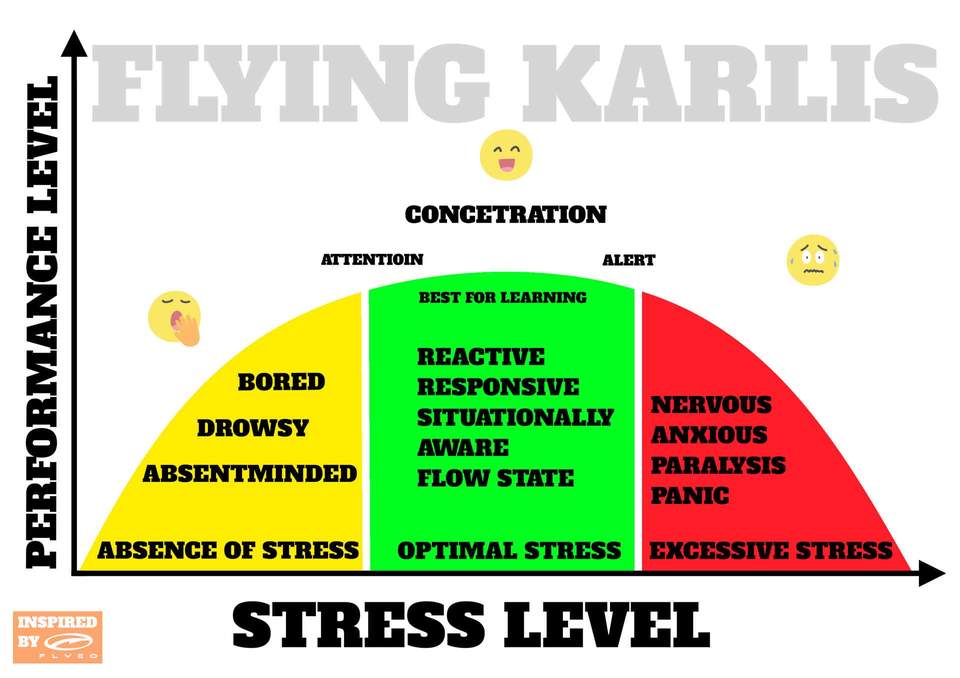
The area with the greatest learning potential is when you are stimulated but not overly stressed. When going into SIV (Simulation d'Incident en Vol), it is expected to experience increased stress levels, leading to nervousness and anxiety. The goal is to avoid reaching the stage of panic and paralysis. However, excessive stress releases chemicals into our blood, which is not conducive to learning and can result in tunnel vision. Consequently, many details may be overlooked, requiring repetition to reinforce learning. Through repetition, we learn to overcome fear and enter a state of optimal learning.
Building our "bubble" is crucial in this process. Initially, when performing a maneuver, we may have limited awareness of factors such as height loss, brake pressure, or limb positioning. Gradually, as we become more familiar with these elements, our bubble expands. This means that we gain a better understanding of our actions and surroundings. SIV involves navigating through this potentially dangerous stage to learn how we will react to different paragliding situations.
However, it is important to note that we can also push ourselves too far in SIV, risking accidents. As our training progresses, we rely more on muscle memory and situational awareness. This allows us to anticipate certain outcomes based on familiar sensations and frees up mental capacity to observe our surroundings, monitor altitude loss, and make decisions such as deploying the reserve parachute. By expanding our bandwidth, we can focus on the bigger picture rather than being narrowly fixated on immediate circumstances.
The key lies in recognizing where we are on this learning curve. It is necessary to experience some level of stress (in the red zone) during SIV but then use repetition to return to the optimal learning state (the green zone) where we are alert and aware of our surroundings.