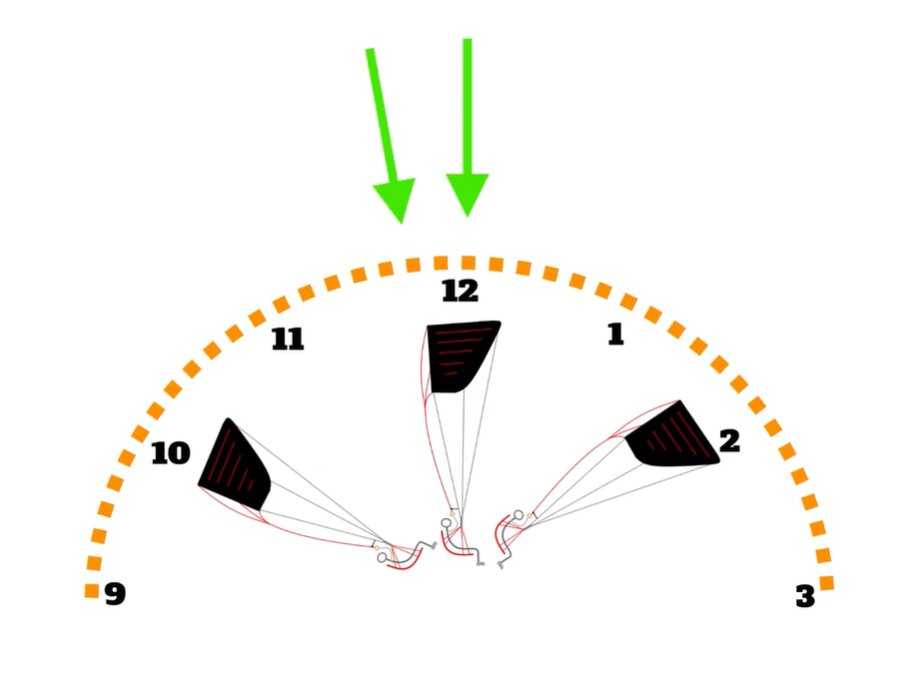
During the course we will use this expression a lot - Catch & release. We also divide the common saying - Pitch Control in two sections Pitch Back and Pitch Forward to clarify the action needed for each.
Pitch Back - hands all the way up.
During pitch back we are looking to have clean trailing edge, this means no brake input whatsoever. As long as we are in pitch back the hands should be up.
As we all have habits especially if we have flown for a while, it is important that during the pitch back we look at our wing to make sure you have hands all the way up. As our hand position changes based on what type of a wrap we are using.
Why is this important?
No matter how much energy we have in a rotation, if we keep our hands up and our trailing edge clean, the wing will not go past about 45 degree pitch-back. The only reason you see wings going more than that in the pitch back, is when pilots add brake input, this helps to generate more energy.
As effectively what you are doing is slowing down the wing, while your body still has inertia. This will “load the wing” (read - add more energy to it), this is what makes you climb higher or in other words your wing to move past the 45 degree angle in the pitch back.
Now that the wing has more energy, and your inertia has run out, you will start falling back to earth as gravity will take over, this will add even more energy to your wing. Creating unnecessary aggressive pitch forward, which if not controlled with full brake input (see Four Fundamentals) can shoot all the way under you before collapsing, or you might have a tumble past the wing or a whip effect. Neither of which is fun.
Pitch Forward - Late catch and release.
Once the wing is passed above our head and is starting to dive forward is when we initiate the catch and release. The following video explains, this in detail.
Over exaggerated late catch and release.
During the course we will ask you to over exaggerate the catch and release. We will also ask you to do so, later and later.
Why is this important?
This does several things. First this trains you to use Full Brake range (one of the Four Fundamentals), as during higher energy maneuvers we will need to use up to 100% of the brake travel to stop the - Pitch forward.
Late catch and release is important for recovery after frontal collapse as well as exits after negative maneuvers, if you start to catch the pitch early after a frontal or a negative (back-fly, parachutal stall) you are risking to re-stall the wing and have a cascade event.